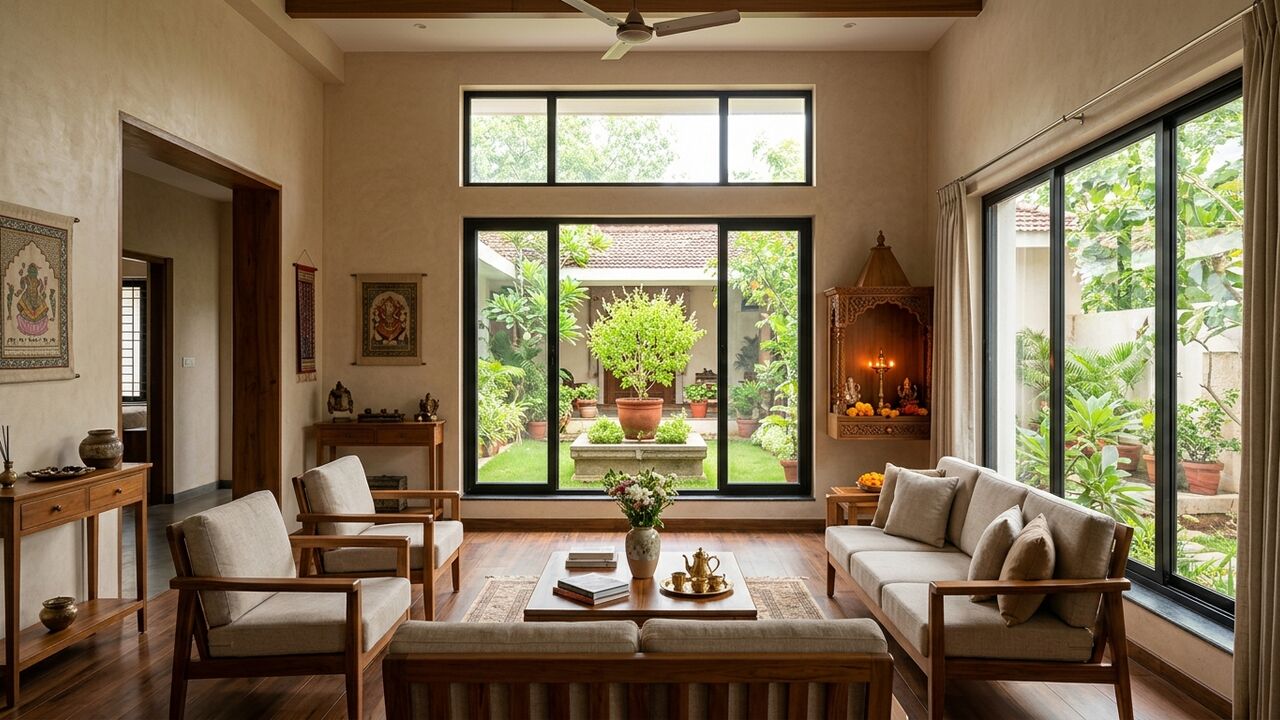
In an Odia home the puja space is where the day begins: the lamp, the tulsi leaf, the conch during Kartik, the small Jagannath, Balabhadra and Subhadra who travel with the family from one house to the next. Designing it well means honouring those habits while solving very practical problems of smoke, oil, marble stains and the fact that most Bhubaneswar flats do not offer a spare room.
Where the Puja Room Goes: North-East and the Practical Alternatives
Tradition and most vastu guidance place the puja room in the north-east (ishan) corner, with the deities facing west so the person praying faces east. Where that corner is available we use it. In apartments the north-east is often a bedroom or a toilet, so we work with the next best positions.
Order of preference we follow
- North-east corner room or alcove, deities facing west or east.
- East wall of the living or dining area, deities facing west.
- North wall, deities facing south (acceptable in most traditions).
- Any wall that is not shared with a toilet, not under a staircase, and not directly facing the main door.
What to avoid
- A mandir against a toilet or kitchen wet wall; moisture stains and the association feel wrong to most families.
- Placement in the bedroom unless a curtain or shutter closes it at night.
- Under the loft or beam where the lamp's heat and soot get trapped.
If you are building a new home, the puja room is easiest to place correctly at the plan stage; our architectural design service plans it alongside the tulsi chaura and the entrance.
Designing Around Odia Rituals
The daily and festival practices in Odisha are specific, and the design should serve them rather than a generic temple image.
- Jagannath trio: the wooden idols are usually 6 to 12 in high and sit on a raised singhasan; give them a 12 in deep, 18 to 24 in wide central platform with a backdrop, and a small canopy or chhatri if the family keeps one.
- Tulsi and the chaura: the outdoor tulsi chaura stays outside, but a small brass tulsi plate or a window-sill pot near the puja space is common; provide a 6 in ledge with a drip tray.
- Lamp and dhoop: a stone or metal tray on the lower platform for the diya and dhoop, at least 12 in from any shutter or fabric; soot and oil spatter decide where wood and marble go.
- Kartik and festival worship: during Kartik the family may light lamps morning and evening for a month; ventilation must handle that.
- Storage: a drawer for incense, camphor, cotton wicks and match boxes; a shelf for the Bhagabata or Gita; a hook for the conch and bell; a cabinet for the special thali sets and puja clothes.
- Water: a small brass lota and a place to rinse; in a larger puja room a 12 in corner sink with a tap is a genuine convenience.
Materials That Look Sacred and Survive Oil, Soot and Humidity
| Material | Character | Care in Odisha | Indicative 2026 cost (₹, for a 3 x 6 ft unit) |
|---|---|---|---|
| Teak (solid frame, carved jali) | Traditional, warm, ages beautifully | Termite resistant; oil stains wipe off; keep away from damp wall | 60,000 to 1,80,000 |
| Sal or other hardwood with teak veneer | Similar look, lower cost | Good; check the veneer PU seal | 40,000 to 90,000 |
| Marble (Makrana or Vietnam white) shrine | Cool, pure, classic | Sealer yearly; turmeric and sindoor stain if left overnight | 45,000 to 1,50,000 |
| Corian / solid surface | Seamless white, carved or backlit jali possible | Fully stain resistant, waterproof, ideal for compact flats | 55,000 to 1,40,000 |
| BWP ply with laminate or PU | Modern, any colour | Excellent in humidity; keep flame 12 in away | 25,000 to 60,000 |
| Brass, copper accents | Bells, chains, lamp hooks | Tarnish in coastal air; lacquer or clean weekly | 3,000 to 20,000 |
Our default for a family home is a teak or teak-veneer frame with a marble or Corian base slab where the lamp and offerings sit, so wood never touches oil. Whatever the material, the shelf that carries the deities should be 18 mm minimum and the base slab should have a 1 in raised lip to stop spilled water reaching the cabinet below.
Lighting and Ventilation for a Puja Space
Lighting
- A warm 2700 K to 3000 K LED strip in a cove above the deities, dimmable if possible; cool white flattens brass and marble.
- Two miniature spotlights (3 W, 24-degree beam) aimed at the main idols.
- A backlit jali panel in Corian or laser-cut MDF with PU finish behind the shrine, using a 12 V strip.
- Concealed sockets for a plug-in electric diya, a small speaker for bhajans and a phone charger; none visible from the front.
Ventilation and fire safety
- A 6 in exhaust fan or a louvred ventilator in a dedicated puja room; in an alcove, a small 4 in inline fan above the cove hidden behind the pelmet removes dhoop smoke.
- Keep curtains, artificial flowers and paper decorations 18 in away from the lamp.
- Choose a granite or marble floor patch or a brass tray under the lamp rather than laminate.
- Do not enclose the lamp in glass; heat builds up and soot blackens the glass within a week.
The electrical points for the shrine must be marked before the ceiling and panels are made; our article on electrical and plumbing planning for interiors explains the sequence.
Small-Flat Solutions: Puja Spaces in 2 to 4 ft
Most 2BHK and 3BHK apartments in Bhubaneswar, Cuttack and Rourkela have no puja room. These are the solutions we build most often.
Wall-hung teak or Corian unit, 24 x 36 in
Mounted at 36 in from the floor on the east or north wall of the living or dining area, with a fold-down shelf for the lamp and two doors that close after the puja. A concealed drawer below stores essentials.
Passage-end alcove, 30 to 36 in wide
The dead end of a bedroom corridor becomes a 30 in wide, 18 in deep, 7 ft high mandir with jali shutters and a cove light. The corridor floor gets a marble patch for standing.
Crockery-unit hybrid in the dining
In a 3BHK the crockery or divider unit carries a 30 in wide puja section at its end, screened with a sliding jali so the shrine is private when the dining is in use.
Under-stair shrine in duplexes
Not ideal by tradition, but if the only option, build it as a free-standing cabinet not attached to the stair, with its own ventilation. Full-size puja rooms are covered in our duplex interior design guide, and more compact ideas in the small apartment interior article.
Full Puja Room Layout for Independent Homes
When a family in Jajpur, Sambalpur or Balasore builds a house, a 5 x 6 ft to 6 x 8 ft puja room is common. Our standard layout:
- Shrine platform 30 in high along the west wall, 18 in deep, with a 6 in high marble step for the deities.
- Cabinets below in teak-veneer ply with brass handles; a 3 ft high dado in marble or granite around the room.
- Sitting area 3 x 4 ft minimum for two people on asanas; a fold-down bench for elders.
- A 2 ft wide double door with a carved or jali panel; a small threshold to keep water in.
- Ceiling: a shallow gypsum cove with a single brass pendant or a carved wooden ceiling panel.
- Window or ventilator to the outside for smoke; a small sink if plumbing permits.
Indicatively, a full puja room of this kind costs ₹1.2 to 4 lakh in 2026 depending on the amount of teak and stone, including cabinets, cladding, lighting and door. Compact wall units start at ₹25,000.
Key takeaways
- Prefer the north-east; otherwise use the east or north wall away from wet walls and the main door.
- Design for the Jagannath trio, daily lamp, dhoop, conch and Kartik worship, not a generic temple image.
- Pair a teak or veneer frame with a marble or Corian lamp slab so oil never meets wood.
- Use 2700 to 3000 K lighting, concealed sockets and a small exhaust for smoke.
- In flats, a 24 to 36 in wall unit or a passage-end alcove serves the family fully.
- Budget ₹25,000 to 4 lakh in 2026 depending on size and materials, indicative only.
Frequently asked questions
Where should a puja room be in an Odisha apartment?
North-east corner if available; otherwise the east or north wall of the living or dining area, away from toilet walls and not directly facing the main door. Deities usually face west or east.
Which material is best for a mandir in humid coastal Odisha?
A teak or teak-veneer frame with a marble or Corian base slab. Corian is fully stain and water resistant for compact flats; brass accents should be lacquered or cleaned weekly near the sea.
How do I handle dhoop and lamp smoke in a closed flat?
Fit a small inline exhaust fan hidden above the cove, keep the lamp on a stone or brass tray at least 12 in from shutters, and never enclose the lamp behind glass.
Can the puja unit be in the bedroom?
Only if it has shutters or a curtain that closes at night. Most Odia families prefer the living or dining area where the whole household can gather.
What does a puja room cost in Odisha in 2026?
Indicatively ₹25,000 to 60,000 for a compact wall or alcove unit, and ₹1.2 to 4 lakh for a full 5 x 6 ft room with teak, marble dado, lighting and cabinets.
Prefer to see it first? Visit the MoGhara experience centre at Panikoili, Jajpur (open daily 9 am – 9 pm) to touch and compare kitchens, wardrobes, finishes and materials before you decide.
Talk to MoGhara about your project in Odisha
Show MoGhara the wall or corner you have in mind and tell us how your family worships; we will design a mandir that fits both, with an indicative estimate. Crafted for you, made for Odia homes.