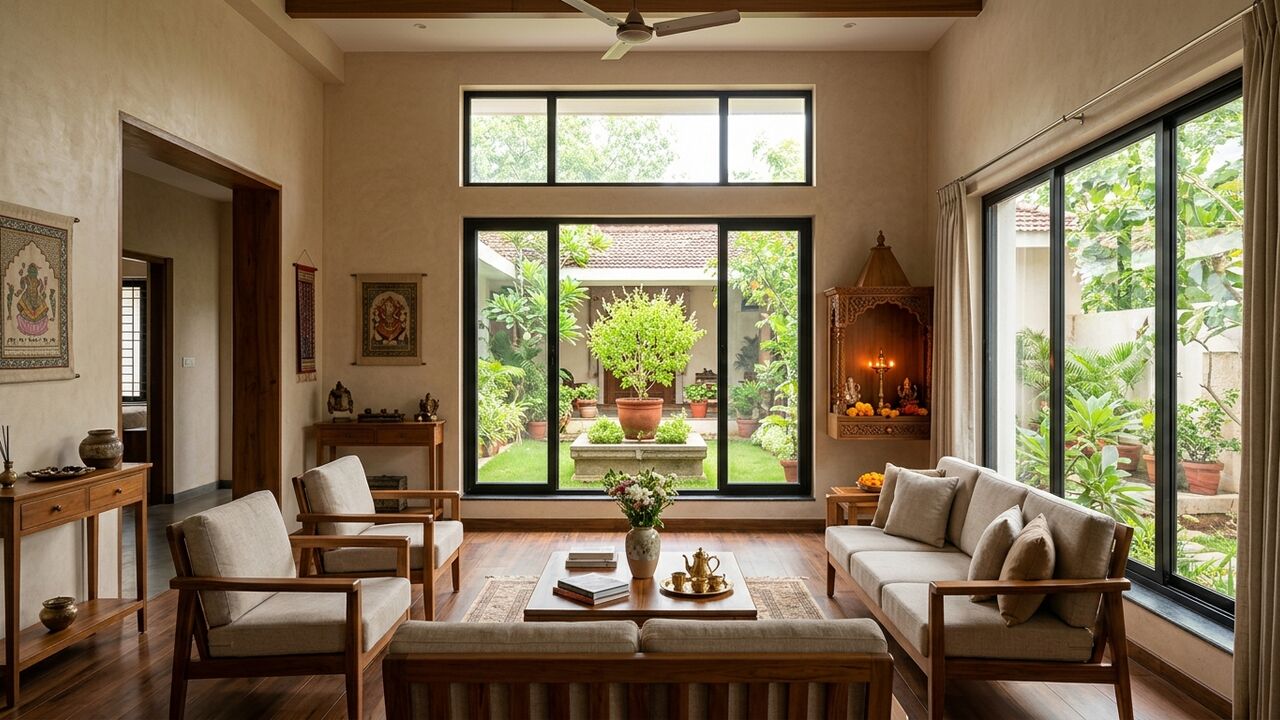
A garden in Odisha has to survive three enemies: salt-laden wind on the coast, a 42-degree western summer and four months of monsoon that can drown roots in a day. It also has to hold a tulsi chaura, a place to sit in the evening and, in many homes, a patch of curry leaf and drumstick for the kitchen. Here is how we plan outdoor spaces that thrive from Puri to Sambalpur.
Read the Site Before You Plant Anything
Every landscape plan we prepare starts with four questions. Where does water go when it rains 150 mm in a night? Where is the afternoon shade? Which direction does the coastal wind come from? And where will the family actually sit?
Soil realities
Coastal plots in Puri, Balasore and parts of Jajpur are sandy and drain fast but hold salt. Cuttack and the Mahanadi delta give clay-rich soil that waterlogs. Laterite in the uplands around Khordha and Jajpur is hard and iron-rich; black cotton soil in western districts swells and cracks. We amend planting beds with 30 to 40 percent compost and coarse sand for clay, and with cocopeat and compost for laterite, before choosing plants.
Sun and wind mapping
Mark the west boundary as the hot side and, on the coast, the south-east as the salt-wind side. Tough screening plants go there; delicate flowering species go in the sheltered north-east.
Landscape planning is easiest when done alongside the building itself; our architectural design service integrates setbacks, drains and garden levels into the plot plan.
Plants That Actually Survive Odisha's Coast and Heat
The list below comes from gardens we have maintained through cyclones Fani and Yaas. Nursery stock is widely available in Bhubaneswar, Cuttack and Sambalpur.
| Role | Plants that work | Why |
|---|---|---|
| Boundary screen / windbreak | Casuarina, Pandanus (kia), Bougainvillea, Clerodendrum inerme, Areca palm | Salt and wind tolerant; kia is the traditional coastal hedge |
| Shade tree (small plot) | Neem, Gulmohar, Kadamba, Ashoka (Saraca), Bakula | Fast growing, deep-rooted; neem also repels insects |
| Kitchen garden | Curry leaf, drumstick (sajana), lemon, papaya, chilli, turmeric, banana | Odia cooking staples that grow with minimal care |
| Flowering | Hibiscus (mandara), Jasmine (malli), Champa, Ixora, Crossandra, Marigold seasonally | Puja flowers; hibiscus and jasmine tolerate humidity |
| Ground cover / edges | Wedelia, Portulaca, Zoysia or Bermuda grass, Lemongrass | Handle heat and heavy rain; lemongrass deters mosquitoes |
| Western Odisha heat | Bougainvillea, Adenium, Plumeria, Peepal (large plots), Mahua | Drought tolerant once established |
Avoid lawn-heavy designs in coastal towns; salt spray browns the grass every summer and the water bill is significant. A 30 percent lawn with 70 percent planted beds and hard paving is our usual balance.
Tulsi Chaura Placement and the Sacred Corner
In almost every Odia home the tulsi chaura is the first thing planned and the first thing the family sees each morning. Traditionally it faces east or sits in the north-east of the courtyard or front yard, with open sky above so the lamp and water offering are not under a slab.
Design details that work
- Height 24 to 30 in, base 18 to 24 in square, built in brick with a lime or cement plaster and painted white or ochre; a laterite or sandstone version looks handsome and weathers well.
- A drainage hole at the base and a 2 in layer of gravel so the tulsi is not waterlogged in July.
- A small niche on the east face for the lamp and a 4 in ledge for flowers; a warm LED uplight on a timer for evenings.
- A 3 x 3 ft paved apron around the chaura in anti-skid stone so the daily pradakshina is safe when wet.
In apartments, a 12 in fibre or terracotta chaura on the east balcony with a drip tray serves the same purpose. Keep it away from the AC outdoor unit exhaust, which scorches tulsi leaves.
Monsoon Drainage: The Part Most Gardens Get Wrong
A beautiful garden in May becomes a swamp in August if levels and drains are ignored. We design outdoor levels before we design planting.
- Slope everything away from the plinth. A 1 in 60 fall for the first 2 m from the house wall, then gentler; the plinth should stand at least 18 in above the finished garden.
- Perimeter drain. A 6 in wide, 9 in deep open or grated drain along the compound wall, connected to the municipal drain or a soak pit sized for the roof and paved area.
- Soak pit. On sandy coastal soil a 4 ft diameter, 6 ft deep pit filled with brickbats handles a 1,500 sq ft roof. On clay soils, double the size or add a second pit.
- Permeable paving. Laterite blocks, interlocking pavers on a sand bed, or gravel joints between stone slabs let water through instead of running it to the gate.
- Rainwater harvesting. Many Odisha municipalities encourage or require it on larger plots; a 5,000 to 10,000 litre underground tank fed from the terrace also cuts the summer borewell load. Check the current rule with your local authority.
Drains and levels are also part of waterproofing the structure; see how we handle these in our civil construction services guide.
Terrace and Balcony Gardens for City Flats
In Bhubaneswar, Cuttack and Rourkela apartments the terrace is often the only outdoor space. Three rules keep it safe and green.
Load and waterproofing
Wet soil weighs about 1,600 kg per cubic metre. Keep planters to 12 in soil depth, place heavy pots over beams and columns, and lay a proper waterproofing membrane with a drainage mat below any raised bed. A 4 in step at the terrace door prevents overflow entering the flat.
What to grow
Curry leaf, chilli, tomato, mint, spinach and lemongrass in 12 in grow bags; hibiscus, jasmine and a dwarf lemon in 18 in pots; a bougainvillea trained on the parapet as a sunscreen. Use a 60 percent shade net over the west half from April to June.
Drip and timer
A 30-plant drip kit with a battery timer costs around ₹3,500 to ₹6,000 and keeps a terrace alive through a fortnight away in summer. Add a 500 litre overhead tank tap for the garden if the plumbing allows, planned with the help of our electrical and plumbing planning notes.
Sit-Outs, Pathways, Lighting and Outdoor Furniture
- Covered sit-out: a 10 x 8 ft pergola or a sloped roof on steel or Sal posts, with an outdoor fan; in cyclone belts anchor posts to a foundation and prefer a flat sheet roof clipped at 600 mm centres, one of the lessons from Fani.
- Pathways: 3 ft wide minimum, laterite or Khondalite slabs on a compacted base, with a brushed finish for grip when wet.
- Lighting: 3000 K bollard lights at 3 m spacing along the path, a wall light at the gate and the door, uplights on one feature tree; all on an IP65 rated circuit with an RCD.
- Furniture: teak, cane over aluminium frame, or granite benches; avoid MS furniture near the coast unless hot-dip galvanised and powder coated.
- Compound wall: a laterite or exposed-brick finish with creepers reads better than a painted wall that streaks with algae every monsoon.
Indicative 2026 Landscape Costs in Odisha
| Item | Indicative range (₹) |
|---|---|
| Soil preparation and levelling | 25 to 45 per sq ft |
| Lawn (Bermuda / Zoysia, laid) | 35 to 70 per sq ft |
| Planted beds with shrubs and ground cover | 90 to 220 per sq ft |
| Laterite or stone paving | 140 to 320 per sq ft |
| Tulsi chaura, masonry with stone finish | 8,000 to 25,000 |
| Perimeter drain and soak pit | 40,000 to 1,20,000 |
| Pergola sit-out 10 x 8 ft | 65,000 to 1,80,000 |
| Garden lighting, 10 to 15 points | 25,000 to 70,000 |
| Terrace garden setup, 300 sq ft with drip | 60,000 to 1,50,000 |
A complete front-and-back garden for a 2,400 sq ft plot typically lands between ₹2.5 and 6 lakh in 2026, excluding large trees and swimming features. Figures are indicative; the site survey decides.
Key takeaways
- Survey soil, water flow, wind and afternoon sun before selecting a single plant.
- Use kia, casuarina and bougainvillea on the coast; neem, gulmohar and mahua inland.
- Keep the tulsi chaura east or north-east, under open sky, with drainage and a paved apron.
- Design levels, perimeter drains and soak pits first; permeable paving keeps the monsoon manageable.
- Terrace gardens need waterproofing, load limits and drip irrigation on a timer.
- Budget ₹2.5 to 6 lakh for a typical plot garden in 2026, indicative and site-dependent.
Frequently asked questions
Which plants survive near the sea in Puri or Balasore?
Casuarina, pandanus (kia), bougainvillea, areca palm, hibiscus and neem tolerate salt wind. Plant them on the sea-facing boundary and keep delicate flowering plants in the sheltered north-east.
Where should the tulsi chaura be placed?
Traditionally in the east or north-east of the front yard or courtyard, under open sky, facing east. Give it a drained base and a paved apron so the daily rounds are safe in the monsoon.
How do I stop my garden flooding in the monsoon?
Slope the ground away from the house, build a perimeter drain to a soak pit or municipal drain, use permeable paving, and keep the plinth at least 18 in above garden level.
Can I make a garden on my apartment terrace?
Yes, with waterproofing checked first, planters limited to 12 in soil depth placed over beams, a drip system on a timer and a shade net for the western half in summer.
What does a home garden cost in Odisha?
Indicatively ₹2.5 to 6 lakh for a full front-and-back garden on a 2,400 sq ft plot in 2026, or ₹60,000 to 1.5 lakh for a 300 sq ft terrace garden.
Prefer to see it first? Visit the MoGhara experience centre at Panikoili, Jajpur (open daily 9 am – 9 pm) to touch and compare kitchens, wardrobes, finishes and materials before you decide.
Talk to MoGhara about your project in Odisha
Share a few photos of your plot or terrace and MoGhara's team will suggest a planting and drainage plan suited to your district, with an indicative estimate. Crafted for you, rooted in Odisha.