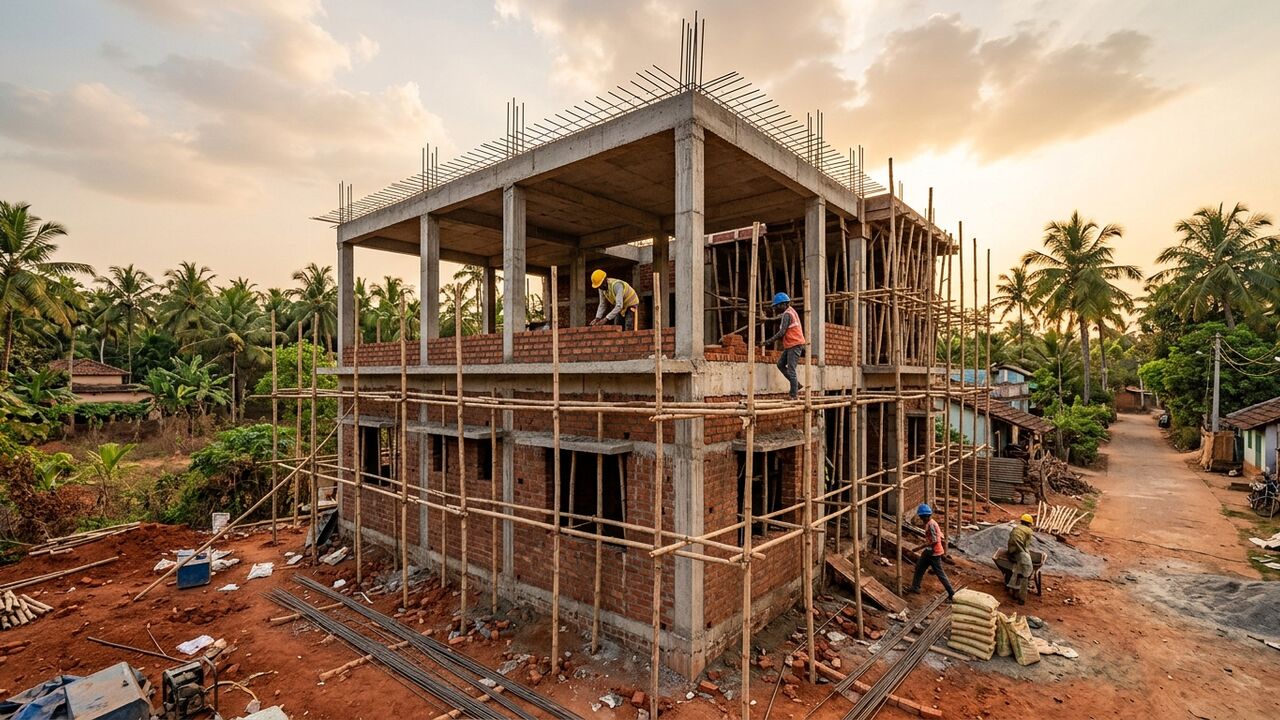
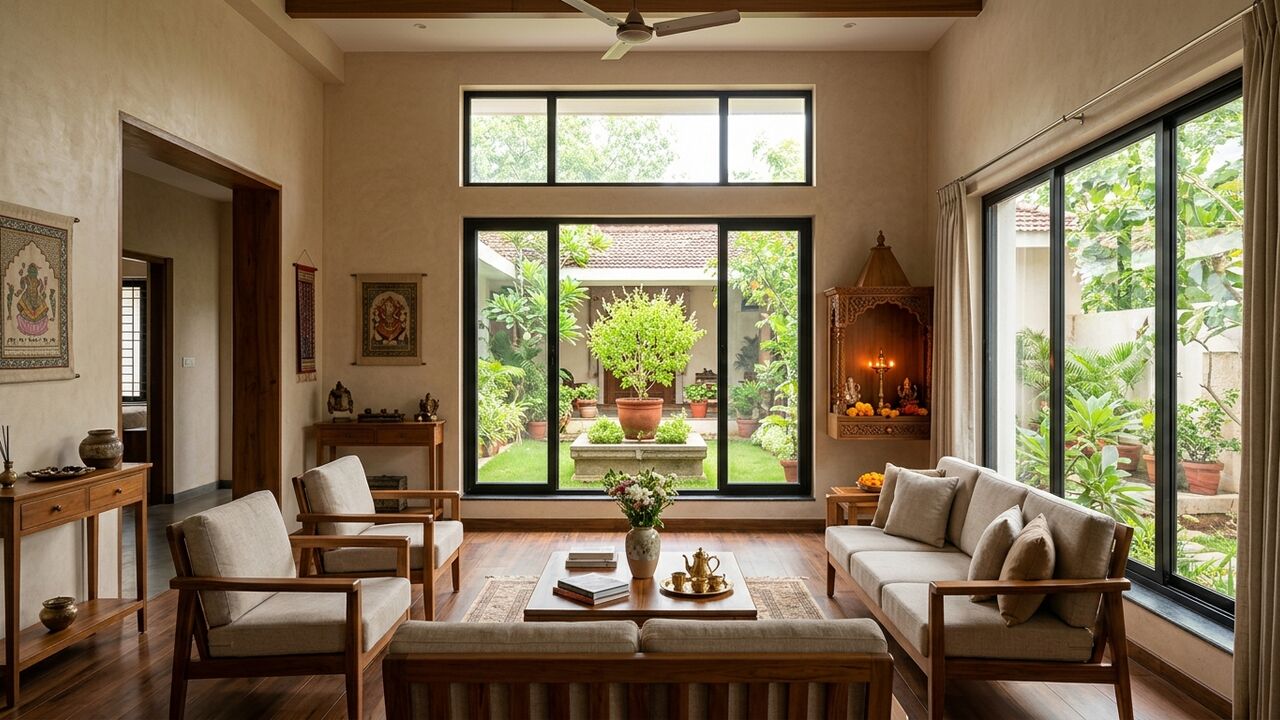
An elevation is the one drawing every family shows to relatives, and the one part of the house the weather attacks hardest. After a few monsoons, many trendy Odisha facades wear black streaks under every ledge; after one cyclone, some lose their cladding altogether. Below are the elevation ideas we use because they still look right five years later, and the materials we have stopped specifying because they do not.
What Odisha's weather does to a facade
Three forces shape every elevation decision here. First, monsoon rain, driven horizontally by the south-west wind, saturates walls for four months and leaves algae and dust trails wherever water runs off an edge. Second, the coastal belt from Balasore to Ganjam faces cyclonic wind; Fani in 2019 peeled ACP sheets, tore off unanchored metal canopies and shattered large unshuttered glass across Puri and Bhubaneswar. Third, western Odisha's dry heat bakes west walls to 60°C surface temperature and cracks thin cement renders. A good elevation is a set of answers to these three, dressed well.
Styles that hold up: four directions we recommend
1. Contemporary box with deep frames
Clean rectangular volumes, but with every window and balcony sitting inside a 300–450 mm deep projecting frame. The frame is the design and the sunshade at once; it throws rain and sun clear of the glass and gives the facade shadow lines that do not depend on paint colour.
2. Odia-modern with stone and timber tones
Plaster in warm off-white, a band of Khondalite or Ganjam sandstone at the entrance, and WPC louvers in teak tone over the staircase or verandah. It nods to the temples and old Cuttack houses without imitating them, and the stone forgives staining far better than white paint.
3. Verandah-first for western Odisha
In Sambalpur, Rourkela or Bolangir, a 1.8–2.4 m deep verandah or double-height porch on the sun-facing side is the elevation. Thick columns, a cantilevered slab and a screen of vertical fins give both shade and a strong facade. It also mirrors what the climate has always asked of houses here.
4. Compact duplex with sculpted parapet
On narrow urban plots the roof line is the only place left for character. A stepped or slotted RCC parapet, a lit pergola frame over the terrace, and a single vertical accent of texture paint take a 25 ft wide frontage from plain to composed. Our duplex design guide shows how the interior follows the same lines.
Material choices, honestly rated for Odisha
| Material | Indicative 2026 cost (₹ / sq ft installed) | Monsoon behaviour | Cyclone behaviour | Verdict |
|---|---|---|---|---|
| Exterior emulsion (silicone-modified) | ₹25 – 40 | Good if walls are dry and edges have drip grooves; repaint 5–7 years | No issue | Base finish for most homes |
| Texture paint / rustic render | ₹60 – 110 | Hides hairline cracks and dust streaks; use on accent bands, not full west walls | No issue | Recommended for accents |
| Natural stone cladding (Khondalite, sandstone, slate) | ₹180 – 350 | Excellent if sealed and pointed; darkens slightly, which reads as patina | Must be mechanically pinned above 3 m, not just adhesive | Best long-term look |
| Cement-based elevation tiles | ₹90 – 160 | Good; joints need proper grout | Adhesive plus pins in coastal zones | Value alternative to stone |
| ACP (aluminium composite panel) | ₹180 – 320 | Stays clean but traps moisture behind if frame is poorly detailed | Poor unless the substructure is engineered; sheets tear off in high wind | Avoid on homes in the coastal belt; limited use elsewhere |
| WPC louvers / fins | ₹220 – 400 | Very good; no rot, wipe clean | Fix to a steel frame anchored into RCC, with fins spaced to let wind through | Recommended |
| HPL exterior boards | ₹300 – 500 | Good UV and rain resistance | Reliable with proper fixings | Premium option for panels |
| Exposed brick / brick tile | ₹70 – 150 | Needs a breathable water repellent every 3–4 years or it grows algae | No issue | Use on sheltered faces |
Whatever you choose, ask the contractor to detail every horizontal ledge with a drip groove and a slight outward slope. That one detail prevents most of the black streaks you see on Bhubaneswar apartment blocks.
Parapets, sunshades and roofs after Fani
The roof edge is where wind pressure concentrates. We now design every coastal-belt house with:
- A solid RCC parapet of 900 mm to 1 m, reinforced and cast with the slab, instead of a brick parapet added later; the slotted or stepped shapes can still be formed in RCC.
- Sunshades (chajjas) cast integrally with the lintel band, 600–900 mm on sun-facing sides, with the outer edge thickened and drip-grooved. A chajja also protects the window seal, which is where most rain leaks start.
- Any metal canopy or pergola bolted to embedded plates in the RCC, never to plaster with expansion anchors.
- Window openings sized so a shutter or plywood panel can be fixed quickly before a cyclone, and toughened or laminated glass for large panes facing the sea.
- Terrace waterproofing that runs up and over the parapet coping, because wind-driven rain enters from the outside face too.
None of this stops you having a contemporary elevation; it just means the drama comes from massing and material rather than from lightweight add-ons.
Colour, texture and staining control
Pure white looks superb in the render and tired by the second monsoon. We steer families toward warm greys, sand, terracotta and stone tones on the main mass, with a single deep accent (charcoal, forest green or a rust texture) on a vertical band. Use the darker tone on the surfaces that stain first: under balconies, around drain outlets and on the lower 1.2 m of walls that catch splash. Choose the exterior material palette with the same humidity logic we apply indoors.
Facade lighting that flatters the house
Lighting is the cheapest way to make a modest elevation look designed. A few rules:
- Light textures, not flat walls: an IP65 wall-washer grazing a stone band or a fin screen creates depth; the same fitting on plain plaster shows every trowel mark.
- Warm white (2700–3000 K) reads better on stone and timber tones than cool white.
- Keep fittings under the chajja or recessed into the soffit so they are protected from rain and do not become a bird perch.
- Wire the facade circuit to the inverter and add a timer; power cuts during festival evenings are common.
- Downlights in the porch, a lit house number and one feature wall are usually enough; over-lit facades look like showrooms.
Getting the elevation and the plan to agree
The most common request we receive is 'this elevation, on my plot'. Elevations are the result of a plan and a structure, not a skin you buy separately. Window positions in the elevation have to match rooms; the deep frame you like has to sit on a cantilever the structural engineer has designed; the double-height porch needs the staircase moved. That is why we develop elevation and floor plan together and model both in 3D before approval drawings are prepared. It is also why material choices are locked before the RCC stage: stone cladding and louver screens need anchors and steel plates cast into the frame. See how those decisions feed into overall budget in our construction cost guide.
Key takeaways
- Design the elevation against rain, cyclone wind and heat first; style comes from massing and material, not add-ons.
- Deep window frames and integral chajjas create shadow, protect glass and stop leaks.
- Prefer natural stone, cement tiles, texture accents and WPC louvers; be cautious with ACP in the coastal belt.
- Cast RCC parapets with the slab and bolt canopies to embedded plates: the Fani lesson.
- Use warm mid-tones and dark bands where staining starts; specify drip grooves on every ledge.
- Develop elevation, plan and structure together and lock cladding decisions before the RCC stage.
Frequently asked questions
Which elevation material is best for coastal Odisha?
Mechanically fixed natural stone or cement elevation tiles, silicone-modified exterior paint and WPC louvers on a steel frame perform best; ACP panels are risky in cyclone-exposed areas.
How do I prevent black stains on my elevation after the monsoon?
Detail every ledge with a drip groove and slope, use darker tones where water runs, keep walls dry with proper terrace and chajja waterproofing, and choose algae-resistant exterior paint.
Is ACP cladding safe for houses in Bhubaneswar?
Only with an engineered aluminium substructure and limited panel sizes. Even then, stone, HPL or WPC are generally better choices in a cyclone-prone region.
How much does a designer elevation add to construction cost?
Indicatively ₹1.5 to 4 lakh extra on a typical G+1 for stone bands, louvers, textured accents and facade lighting, depending on how much of the frontage is treated.
Are deep sunshades necessary on a modern elevation?
Yes in Odisha. Sunshades protect windows from driving rain and direct sun, and they are the main source of shadow and depth in a contemporary facade.
Can you design an elevation for an existing house?
Yes. Elevation upgrades on existing homes are a common part of our renovation work, usually combining new chajjas, texture bands, louvers and lighting without structural change.
Prefer to see it first? Visit the MoGhara experience centre at Panikoili, Jajpur (open daily 9 am – 9 pm) to touch and compare kitchens, wardrobes, finishes and materials before you decide.
Talk to MoGhara about your project in Odisha
Want an elevation that looks as good in year six as in the render? Share your plan or plot with MoGhara and we will propose two or three facade directions with honest material costs.